
Golden Lights
The Song Johnny Marr Hated - and Morrissey Never Forgot

The Smiths recorded “Golden Lights” at London's Jam Studios in June 1986 with producer John Porter, alongside “Ask” and an early version of “Is It Really So Strange?” Craig Gannon provided rhythm guitar on the track. Just as Morrissey had bypassed Porter by having Steve Lillywhite perform the final mix on “Ask,” he handed “Golden Lights” to producer Stephen Street for mixing (or, according to some accounts, to be “f*cked up” at Morrissey's instruction1) before Porter had the opportunity to complete his own mix. As a result, the finished recording sounded markedly different from what Porter had originally envisioned, including prominent bossa nova-style guitars that Street largely muted in the final mix.2 The late English singer-songwriter Kirsty MacColl contributed backing vocals.
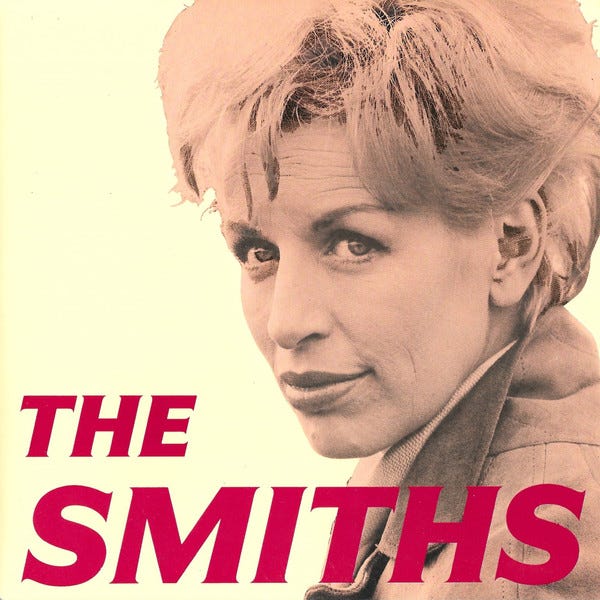
Written by English singer-songwriter Lynn Annette Ripley3, better known by the stage name Twinkle, “Golden Lights” was released as a single in February 1965, peaking at number 21 on the UK Singles Charts the following month.4 Twinkle’s original version can be heard here:
While the Smiths remained faithful to the melody of Twinkle’s original recording, their interpretation adopted a markedly different atmosphere. Whereas Twinkle’s version is unmistakably rooted in the pop sensibilities of 1965, the Smiths transformed the song into something darker and more unsettling. Atmospheric and ethereal, and enhanced by Kirsty MacColl’s haunting backing vocals, the recording represents a significant departure from the sound and style of the original.
Although Morrissey largely retained Twinkle's lyrics, which meditate on the ways fame and success can alter a person's identity and relationships, he made several subtle revisions that intensify the song's underlying sense of disappointment, loss, and betrayal. Twinkle's "golden lights" - a likely metaphor for fame and its attendant glamour- are transformed by Morrissey from "a whole lot of fame" into a "terrible shame," while other alterations make the lyrics more direct and accusatory, placing greater emphasis on the refrain, "Why did you change?" The result is a darker, more melancholic interpretation that accentuates the emotional cost of success and the sense of personal loss already present in the original lyric.
Listen to the Smiths’ cover of the song in the following link:
Release History
The Smiths released "Golden Lights" on 20 October 1986 as a B-side to the 12-inch edition of the "Ask" single, alongside "Cemetry Gates." The song was later included on the compilation album Louder Than Bombs, released in March 1987, and subsequently appeared on the 2011 compilation Complete.
The runout groove on the B-side of the UK release was etched with the phrase “TOMB IT MAY CONCERN,” a clever pun on “To whom it may concern” that likely alludes to the cemetery imagery of “Cemetry Gates.”
The Fault Line Beneath the Music
“Golden Lights” is generally regarded by many (though not all) Smiths fans as the weakest song in the band's catalogue, owing to its unusual arrangement, Morrissey's distorted vocals, and a style that stands distinctly apart from the Smiths' main body of work. Unsurprisingly, Johnny Marr detested the track, singling it out along with “Work Is A Four Letter Word” as being the nadir of the band’s output:
"Yeah, that [recording 'Golden Lights'] was another low point. Those are the two low points of our recording career [the other being “Work Is A Four Letter Word”], certainly. They're really inferior, and don't deserve a place alongside our own material."5
One can almost picture Marr gritting his teeth in the studio while recording “Golden Lights.”
When Morrissey suggested to Marr that they record The Cookies'6 “I Want A Boy For My Birthday”7 in August 1982, Marr enthusiastically embraced the idea, recalling, “Great, this'll really freak ’em out! I was really happy to encourage it.”8 To be fair, the recording was never intended for release, having been made solely to help newly recruited bassist Dale Hibbert familiarize himself with the song - and, perhaps, the fledgling band's aesthetic - ahead of its debut performance. Indeed, the fact that Hibbert never bothered to return the recording speaks to its originally fleeting and informal purpose.9
The bonhomie that characterizes many productive creative partnerships was doubtless at play when Morrissey persuaded Marr to record a largely forgotten song by an American girl group. By 1986, however, the pair had already written a substantial body of work together, rendering the need to delve into the depths of 1960s pop obscura in search of B-sides an unnecessary exercise at best. Indeed, less than a year later, Morrissey's insistence that the Smiths record Cilla Black's “Work Is A Four Letter Word” proved to be the final straw for an exhausted and increasingly frustrated Johnny Marr.
Morrissey's Defence of Playful Perversity
Morrissey's view of “Golden Lights,” and the Smiths' other cover versions - including James' “What's the World?” - was more balanced and considerably less severe. In a 2007 Q&A on True To You, he explained:
“Everything has its place and its reason. Certainly, the early Smiths covers, for example ‘Work is a four-letter word’ and ‘Golden lights’ were done as acts of playful perversity - they weren’t meant to be groundbreaking miracles of sound. And that’s usually how it is, just a matter of throwing something unexpected into the mix.“
Covering near-forgotten songs by Twinkle and Cilla Black can reasonably be construed as a form of indulgence on Morrissey's part. By 1986, the Morrissey–Marr songwriting partnership had fully blossomed, producing a body of work that propelled the Smiths into the rarefied heights of the British indie scene and beyond. While Marr viewed such cover versions as unwelcome distractions, Morrissey saw them as playful diversions - a musical equivalent of a tonic to take the edge off the world-weary melancholia that permeated much of the Smiths' catalogue.
Morrissey’s motivation was not without precedent. One is reminded of the Beatles’ “Wild Honey Pie” from their eponymous 1968 album - a playfully anarchic musical doodle (and, to some ears, a gratingly inane one at that) inserted among songs widely regarded as the apogee of the band’s creative output. Then there is “Revolution 9,” from the same album, a piece so avant-garde that it is better described as a sound collage than a song in the conventional sense.
In the decision to release such tracks, one can discern a certain artistic confidence on the part of Lennon and McCartney. Rather than reflecting laziness or a decline in their creative powers, these recordings suggest a band that no longer felt compelled to prove itself. By that point in the Beatles’ career, the scope and quality of their work had already rendered such validation unnecessary.
Reappraising “Golden Lights”
“Golden Lights” is something of an acquired taste, possessing a strange, almost
