
The Queen is Dead

"It was always about ten, 15 minutes long. It just happened in the studio, didn't it? It was like a Beatles mad 'I Am The Walrus' metal jam... That track was done right at the end of the sessions, wasn't it? Mozz didn't even have a title for the album at that stage..."1
- Andy Rourke on the song "The Queen Is Dead"
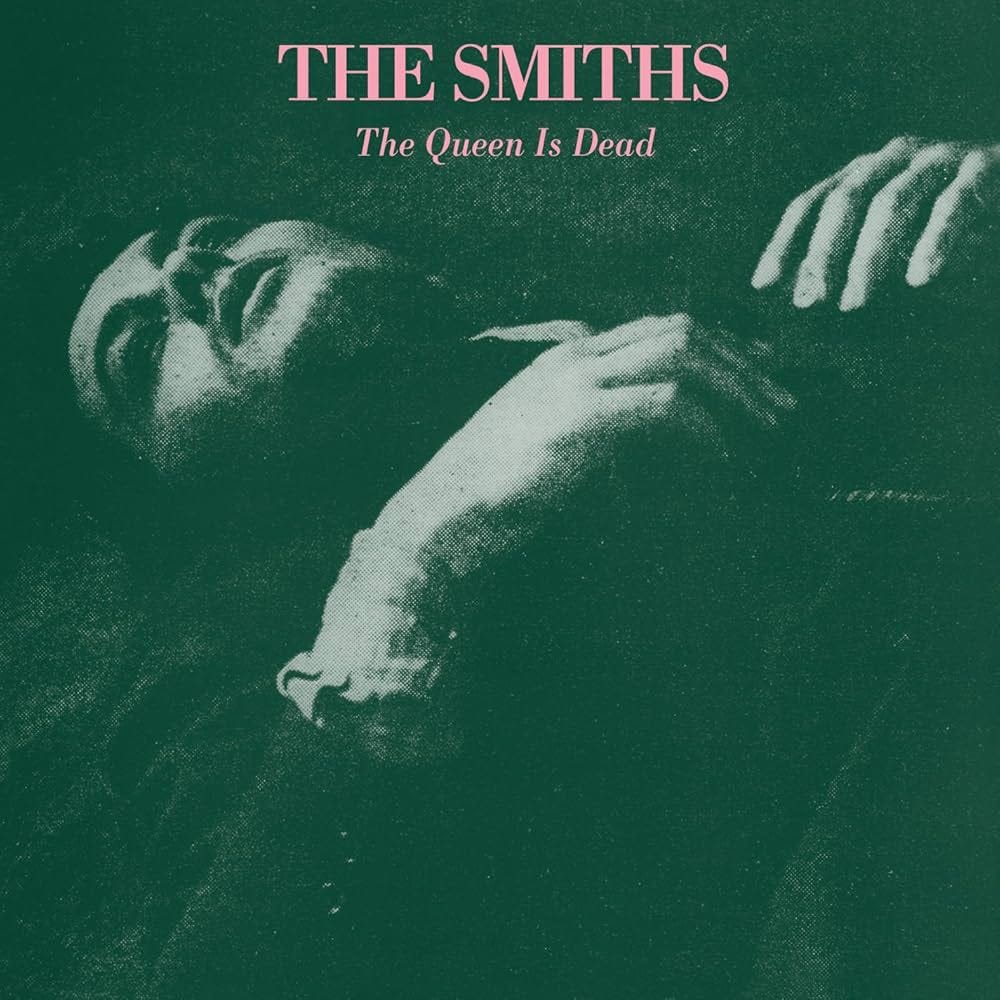
The Queen's First Death
The story of “The Queen Is Dead” actually begins with a live performance of “Barbarism Begins at Home” at the Beacon Theater in New York City on 18 June 1985 during the North American leg of the Smiths’ Meat Is Murder tour. The band closed their second consecutive night at the Beacon with “Barbarism,” during which Morrissey ad-libbed the line, “the queen is dead.”
Listen at 2:50 in the following clip to hear the added line:
This erudite reference, almost certainly drawn from the title of a story in Hubert Selby Jr.’s2 1964 novel Last Exit to Brooklyn,3 was more than a casual literary flourish. The title’s associations with domestic abuse and social cruelty resonated closely with the themes already present in “Barbarism Begins at Home.” Nevertheless, it was likely intended at the time as little more than an offhand allusion, deployed to deepen the already unsettling atmosphere of the song.
The Queen Is Dead is the title of the second of Selby’s six loosely connected stories in Last Exit to Brooklyn. In Selby’s novel, the “Queen” is Georgette, a sharp-tongued, drug-addled transgender prostitute who is subjected to domestic abuse at the hands of her violently homophobic brother:
“She had come home one morning with one of her friends after a three day tea party with her makeup still on and her older brother slapped her across the face and told her that if he ever came home like that again hed kill him. She and her friend ran screaming from the house calling her brother a dirty fairy. After that she always called to see if her brother was in before going home.”4
Selby prefaced the story with a quotation from Genesis 1:27: “So God created man in his own image, in the image of God created he him; male and female created he them.”
This inclusion is profoundly ironic. A passage affirming humanity as God's creation is placed before a story in which the protagonist is abused for expressing an identity that challenges conventional notions of “male” and “female.” The result is a striking paradox: those who claim allegiance to divine order become agents of cruelty, placing society itself - not the protagonist - at odds with the spirit of the biblical text.
Within the context of “Barbarism Begins at Home” - a song that argues brutality originates not in society at large, but within its supposedly civilizing institutions: the home, the family, and the school - Morrissey’s ad-libbing of Selby’s title is yet another example of his gift for clever and ironic intertextuality in performance. At the same time, this seemingly offhand utterance on a clement June evening in New York City in 1985 marked the first appearance of a phrase that would soon lend its name to one of the Smiths’ most iconic songs.
Out of Noise, Something Beautiful
“The Queen Is Dead” was recorded by the Smiths in the autumn of 1985 at Jacobs Studios in Surrey, alongside most of the material that would appear on the album The Queen Is Dead. Morrissey and Johnny Marr produced the recording themselves, with Stephen Street serving as recording engineer. The track, in forma prima, ran in excess of seven minutes and concluded with a planned fade-out. Street recommended that it be shortened by approximately one minute and that the fading outro be removed.
Listen to the original full version of “The Queen Is Dead” here:
While Morrissey drew upon literature, contemporary events, and his own social observations in shaping the song's title and lyrics, the distinctive sound of “The Queen Is Dead” emerged through a creative synthesis of ideas brought to the studio by the entire band. Morrissey himself contributed the suggestion of opening the track with the wartime standard “Take Me Back to Dear Old Blighty,”5 but the song's ferocious sound owed much to Johnny Marr's enthusiasm for the Stooges, MC5,6 and other proto-punk influences including the Velvet Underground.7 When Johnny Rogan observed during a 1992 Record Collector interview that the song was “...obviously influenced by the Stooges and the MC5,” Marr readily embraced the comparison, offering a lengthy and far-ranging response:
“Yes, I just traced it back. It was Morrissey’s idea to include ‘Take Me Back To Dear Old Blighty’ and he said, ‘I want this on the track’. But he wasn’t to know that I was going to lead into the feedback and drum rolls. It was just a piece of magic. I got the drum riff going and Andy got the bass line, which was one of his best ever and one that bass players still haven’t matched. I went in there with all the lads watching and did the take and they just went, ‘Wow’. I came out and I was shaking. When I suggested doing it again, they just said, ‘No way! No way!’ What happened with the feedback was I was setting my guitar up for the track and I put it onto a stand and it was really loud. Where it hit the stand, it made that note of feedback. I did the guitar track, put the guitar on the stand, and while we were talking, it was like, ‘Wow, that sounded good’. So I said, ‘Right - record that!’ It was going through a wah-wah from the previous take, so I just started moving the wah-wah and it was getting all these different intervals, and it definitely added a real tension. I loved Morrissey’s singing on that, and the words. But it was very MC58. Morrissey has a real love for that music as well. I remember him playing the Ramones as much as he played Sandie Shaw.”9
Marr later expanded upon the accidental feedback effect described above, explaining in greater technical detail how one of the recording's most distinctive sonic features emerged from the manipulation of a resonating harmonic and a wah-wah pedal:
“I’d done the rhythm track for The Queen Is Dead, and left the guitar on the stand. The wah pedal just happened to be half open, and putting the guitar down made the guitar suddenly hit off this harmonic. We were back at the desk playing back the rhythm track and I could still hear this harmonic wailing away, so we put the tape back onto record while I crept back into the booth and started opening up the wah-wah, thinking ‘Don’t die, don’t die!’ Eventually I opened up the pedal, and ‘Wooooohhhhhh!’ Kept it going, too. Great accident...”10
From Andy Rourke’s perspective, much of the song’s development owed itself to the simple expedient of extensive jamming in the studio:
“Sometimes you can go into the studio and you can play for a whole day and nothing will happen. That day magic happened and we came up with this amazing song that became the theme of the whole album.”11
Mike Joyce’s thunderous drum introduction was achieved through an innovative recording technique suggested by engineer Stephen Street. Joyce had devised a relentless rolling tom-tom pattern that gave the song its driving urgency, but found it impossible to maintain the continuous drum roll while simultaneously performing the snare fills, cymbal crashes, and other embellishments required by the arrangement. Street therefore had Joyce record the tom-tom pattern separately, sampling and looping a short section using an antiquated sampler before overdubbing the remaining drum parts.12 As Street later recalled, “We got Mike to play this rumbling rhythm and then sampled a small section of it.”13
Joyce initially regarded the process as “a bit like cheating,” but ultimately conceded that Street's approach allowed them to achieve an extraordinary sonic effect. The resulting layered drum track became one of the defining features of the recording and helped propel the song's ferocious momentum. Ironically, Joyce's concerns about reproducing the part live proved unfounded. Despite the studio trickery employed to create the recording, he successfully replicated its power and urgency in concert, a feat that should put to rest any lingering doubts about his considerable abilities as a drummer.14
Equally essential to the recording's momentum is Andy Rourke's extraordinary bass performance. Rather than merely anchoring the rhythm, his fluid and melodic playing intertwines with Marr's guitar work, adding both propulsion and complexity to the track's relentless drive. Marr's admiration for the bass line is understandable; its combination of power, movement, and melodic invention remains one of the recording's most celebrated features. The following link contains an instrumental demo of the song that showcases Rourke’s nimble bass playing in remarkable detail, revealing why, decades later, it still stands as one of the defining bass performances in the Smiths’ catalogue:
Morrissey, meanwhile, matched the intensity of the instrumental performance with one of the most urgent vocal deliveries of his career. Singing in a rapid, almost breathless cadence, he sounds less like a detached commentator than a man attempting to outrun the social decay, political malaise, and personal frustrations described in the lyrics. The result is a performance that transforms what might otherwise have been a sardonic social critique into something far more immediate and visceral.
Beyond the Monarchy
In appropriating Selby’s work for the title of the Smiths’ 1986 album and its opening track, Morrissey was almost certainly invoking not merely the words themselves, but the atmosphere of alienation, moral exhaustion, and outsider identity permeating Last Exit to Brooklyn; themes that resonated deeply with his own experience of post-war industrial England. In this sense, “The Queen Is Dead” becomes more than a provocation aimed at the monarchy15, suggesting instead the spiritual decay of an older Britain already long in decline.
Notwithstanding its beginnings, Morrissey’s finalized lyrics for the song ultimately operate on several levels at once, addressing family repression, religious hypocrisy, class consciousness, youth disaffection, sexual unease, poverty, and the suffocating rituals of everyday English life, all filtered through his characteristic mixture of irony and mordant humor.
Adding a twist to the matter, Morrissey later asserted that “The Queen Is Dead" was not to be taken too literally as being an anti-monarchist diatribe:
“It doesn't necessarily mean Queen Elizabeth. There's a safety net in the song... that the old queen in the lyrics is actually me. So when they lynch me or nail me to the cross, I have that trapdoor to slide through. But, having said that, the song is certainly a kind of general observation on the state of the nation."16
